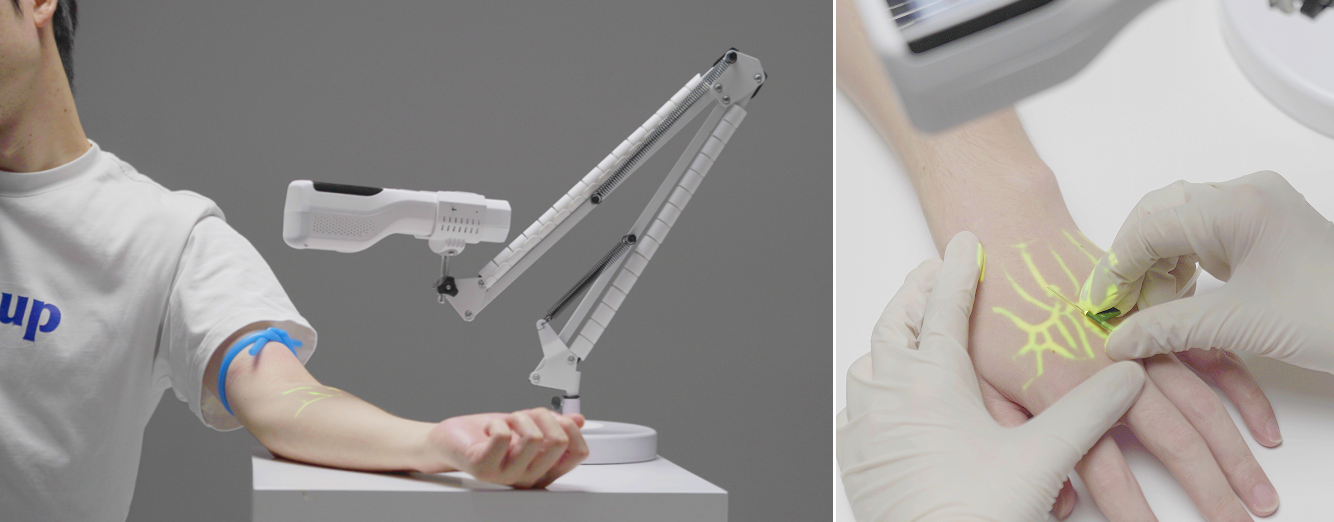
A near-infrared vein finder helps oncology nurses see and grade the superficial veins that remain usable after weeks of chemotherapy, choose the best forearm segment for each infusion cycle, and avoid "wasting" scarce vein real estate on difficult sticks. It does not replace central access decisions: per infusion therapy standards, vesicant chemotherapy, long durations (> 6 days) or irritant infusions still require PICC, midline or port assessment — the vein finder's job is to make every peripheral stick count while peripheral access remains appropriate.
Where a Vein Finder Changes the Workflow
1. Mapping the surviving veins before the first stick
Near-infrared imaging projects the superficial vein network (typically imaging vessels 1–8 mm below the skin) directly onto the arm in real time. For a patient with scarred, fragile vasculature, the nurse can survey the whole forearm in seconds: see which segments are continuous, which show valve shadows or gaps, and which candidates survived previous cycles.
The practical gain is subtle but important: instead of "one best guess plus one rescue stick," the nurse sees three to four graded options before touching the patient — and can save the best one for the infusion that needs it most.
2. Separating "visible" from "usable"
The projection shows anatomy, not health. In oncology practice that distinction is exactly what matters:
- Confirm with palpation and refill: compress or tap the site — a healthy vein blanches and refills instantly; a sclerosed or thrombosed segment stays dim or refills slowly.
- Grade before you stick: long, straight, ≥ 2 mm segments away from previous cannulation marks come first; short curved segments near scars come last.
- Respect the one-stick principle: many oncology units limit nurses to two attempts before escalation. A vein finder raises the odds that attempt one is also the last.
3. Protecting patients during off-cycle access
Between cycles, the same patients still need blood draws, hydration and supportive-care infusions. Staff who were not part of the original care team benefit most from the projection: a locum or float nurse can find the surviving forearm veins without exploring by trial and error — which is precisely how scarce veins get destroyed.
4. Supporting vein-sparing protocols
Vein preservation guidelines encourage starting distally and moving proximally across a treatment course. A real-time projection makes that rotation systematic: document which segment was used this cycle, scan past it next cycle, and the forearm's vein capital lasts months longer.
What a Vein Finder Cannot Do in Oncology — and Should Not Be Asked To
Being honest about limits protects patients:
- It does not measure vein wall health. A vein that projects beautifully can still have fragile walls after prior phlebitis; the infusion decision needs clinical judgment.
- It does not see deep veins. Near-infrared reaches roughly 8 mm — sclerotherapy-damaged deeper veins belong to ultrasound assessment.
- It does not change central access criteria. Vesicant chemotherapy, infusions longer than ~6 days, and unstable veins escalate to PICC, midline or implanted port under infusion therapy standards, regardless of how well the peripheral veins project.
- It does not prevent extravasation after insertion. Securement, monitoring and patient education still carry that job.
Framing the device this way also answers the question oncology managers actually ask: does it help us, or does it delay escalation? Used as an assessment aid — "make the peripheral stick count, then escalate on time" — it does the former.
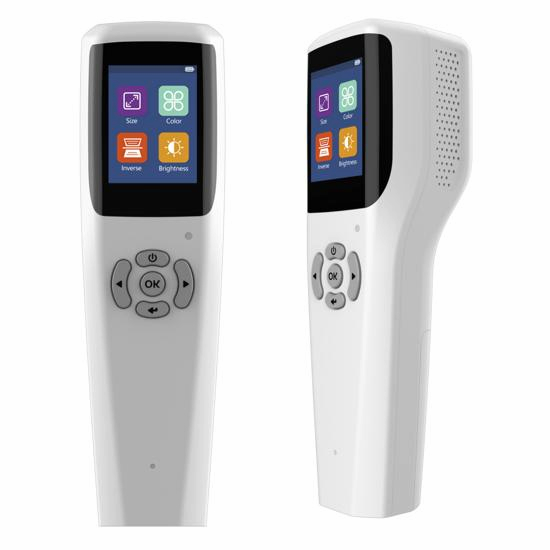
Devices like ZD Medical's near-infrared systems (850 nm projection imaging, offered in handheld, desktop stand and mobile trolley configurations, with adjustable green/red projection and inverse mode for different skin tones and lighting conditions) are designed around exactly these ward realities — see how to choose the right vein finder for different clinical settings for the full decision framework.
FAQ: Oncology Teams Ask These Most
Can a vein finder be used on patients receiving chemotherapy?
Yes — there is no contraindication. The device projects near-infrared light onto the skin surface; it is non-contact, non-invasive and adds no discomfort. It is in fact most valuable for exactly these patients, whose superficial veins are hardest to assess visually.
Does a vein finder reduce the need for PICC lines?
No, and it should not. Central access decisions follow therapy criteria (vesicant agents, duration, vein condition). The device's role is to maximize the quality and lifespan of peripheral access while peripheral access remains appropriate — not to postpone indicated escalation.
Why do chemotherapy patients' veins disappear between cycles?
Repeated cannulation causes sclerosis, fibrosis and local thrombosis; dehydration and weight loss during treatment reduce fill pressure as well. The veins are still there — but they drop below the visibility and palpability threshold, which is what near-infrared projection restores.
Is red or green projection better for oncology patients?
Neither is universally better: green reads crisply in dim treatment rooms, while red projection tends to offer better contrast on darker skin tones and under brighter ambient lighting. Devices with switchable colors let the nurse match the room and the patient rather than the other way around.
How do we train staff to use it consistently?
One 15–30 minute session covers it: scan the forearm, read continuity and valve shadows, confirm with palpation and refill, then insert beside the projected line. The hard part is workflow, not technique — units that write "scan before first attempt" into their difficult-IV-access protocol get consistent adoption.
Contact ZD Medical
- Email: sales@zd-med.com
- Tel: +86-25-51809558
- Mobile / WhatsApp: +86 187 9586 9515 (9:00–17:30 China time)
- Address: Room 301, 3rd Floor, Building 8, No. 19, Jugong Road, Xixing Street, Binjiang District, Hangzhou City, Zhejiang Province, China
- Website: www.zdmedimage.com


 IPv6 network supported
 English
 español
 العربية


